Two readings, both sound, pointing opposite ways
On the monthly report's basis — calendar-month departures, one consistent product — the United Arab Emirates had a strong July: 658 departures against 524 in June, a gain of 134. The report lists it among only five markets outside Europe and North America that it names as the month's fastest-growing, alongside Vietnam at 373 from 193, Qatar at 136 from 72, and the Philippines and Egypt. Nothing in that table suggests a market in trouble.
The daily insight layer, measuring the same country in the same month, reports the opposite. Flights departing the UAE lasting more than 300 minutes totalled 223 in July 2026 against 291 in July 2025, a loss of 68, and the card states that both sides are complete calendar months on a comparable basis. Royal Jet led those long flights with 28, Vista Jet followed with 21 and Avcon Jet with 12.
Before calling either an artifact, check that the two products see the same market. They do. Report departures for May, June and July run 329, 524 and 658; the insight card's UAE movement series for those months runs 640, 1,030 and 1,217 — ratios of 1.95, 1.97 and 1.85, consistent with movements counting both the departures and the arrivals of the same flights. The datasets agree on the level. They disagree because they answer different questions: how many flights, and how far.
| Item | departures |
|---|---|
| 2026-02 | 1,139 |
| 2026-03 | 287 |
| 2026-04 | 345 |
| 2026-05 | 329 |
| 2026-06 | 524 |
| 2026-07 | 658 |
The corridors that need the biggest aircraft are the ones emptying
Widen the window and the loss deepens. Across May 1 to July 30 the UAE recorded 477 departures over 300 minutes against 1,053 a year earlier, down 54.7%. The European destinations fell hardest and fell together: Germany 72.3%, Spain 70.2%, Switzerland 64.5%, France 63.4%. The United Kingdom held first place with 91 flights on a milder 44.2% decline, which lifted its share of the total from 15.5% to 19.1% — first place by shrinking less. China fell least at 29.3% and rose from seventh to fourth.
The corridor detail is sharper. Long-haul legs from the UAE to Europe ran 289 in the 90 days to July 26 against 519 in the preceding quarter, a loss of 230. One route is a fifth of that: Moscow fell from second place with 54 flights to seventh with 7, a loss of 47. Zurich dropped out of the top ten as Swiss arrivals concentrated on Geneva. London went the other way, rising from 69 flights to 75 and holding first place outright.
Three windows give three depths — 54.7% over the 91 days to July 30, 44.3% quarter-on-quarter to July 26, 23.4% for the July calendar month — and they are not interchangeable. The shallowest is the newest and the only clean calendar-month comparison, so it is the one to build on. What all three share is where the loss sits: not spread across the UAE's flying, but concentrated in the segment that requires the largest and most expensive aircraft.
| Item | % YoY, flights over 300 minutes |
|---|---|
| China | -29.30% |
| United Kingdom | -44.20% |
| UAE total | -54.70% |
| France | -63.40% |
| Switzerland | -64.50% |
| Spain | -70.20% |
| Germany | -72.30% |
Every gateway that publishes a window is down, and the designated one is down most
Dubai's Al Maktoum is the case that should not happen. Dubai concentrated business aviation there in November 2025, making it the emirate's designated field. Over the most recent 90 days OMDW logged 1,480 movements against 3,433 a year earlier — a loss of 1,953, or 56.9% — with the daily average falling from 37.7 movements to 16.1. The year-ago window predates the consolidation, so the sole designated airport now shows well under half the traffic it carried while sharing the role. Every leading operator shrank with it: VistaJet 313 to 181 and still first, Falcon Luxe 183 to 115, Avcon Jet 122 to 35, Falcon Aviation 106 to 64.
What OMDW still flies is the clearest evidence of the shortening. Its destinations are led by short Gulf hops — Abu Dhabi at 55 movements and Riyadh at 31 — with Mediterranean summer overflow to Bodrum and Istanbul layered on top. The airport designated for the region's long-range traffic is in practice running a Gulf shuttle with a seasonal European tail.
The neighbours did not absorb what Dubai lost. Sharjah recorded 118 movements between May 7 and August 4 against 315 a year earlier, down 197 and 62.5%, with a single operator, Avcon Jet, accounting for 37 of them, about 31%. Muscat, one emirate further out, logged 245 movements between May 8 and August 6 against 307, down 20.2%, after evacuation flying tied to the Iran conflict had lifted March and April to 377.
Abu Dhabi points the same way but cannot carry weight on its level. Zayed International logged 601 movements from January 1 to July 21 against 1,204 a year earlier, down 50.1%, with Royal Jet at 287 — roughly half the airport — and VistaJet at 52. Two things limit it. The reading covers Zayed International only, not Al Bateen, the emirate's dedicated business-aviation field. And the same card's own monthly series sums to 1,046 movements for January to June against the 601 it states for the longer window, so the two figures on that card are not on one basis. Direction yes; level no.
| Item | % YoY, movements; windows differ |
|---|---|
| Muscat OOMS (90 days) | -20.20% |
| Dubai OMDW (YTD) | -40.70% |
| Abu Dhabi OMAA (YTD) | -50.10% |
| Dubai OMDW (90 days) | -56.90% |
| Sharjah OMSJ (90 days) | -62.50% |
The money is buying the half that left
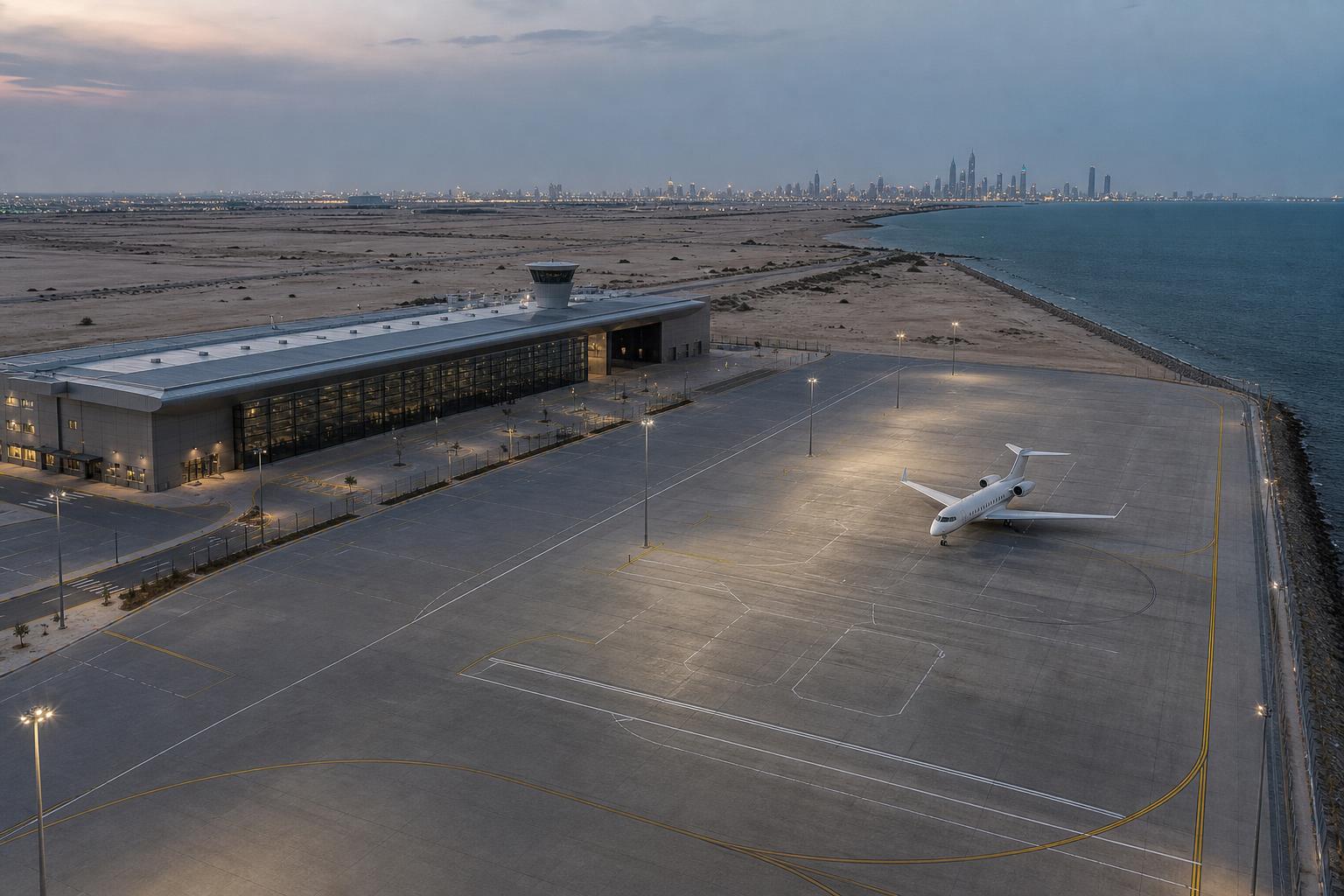
Gama Aviation opened its expanded Sharjah FBO in May 2026 at seven times its former size, an investment of roughly USD 60 million, aimed explicitly at operators squeezed by Dubai's slot limits and at large ultra-long-range jets of the Global 7500 class. In its first 90 days the airport handled 118 movements, about 1.3 a day, with 31% of them from one operator. It is not underused because it was built badly; it is underused because the traffic it was sized for is the traffic that left.
The type detail makes the mismatch precise. The aircraft actually flying the UAE's surviving long-haul in July was the Boeing BBJ at 41 movements, ahead of the Global 6000 at 29 and the Global 7500 at 15. A facility specified around the 7500 is serving a segment in which that type ranks third.
The largest commitment is the newest. On July 21 at Farnborough, The Helicopter Company — owned by Saudi Arabia's Public Investment Fund — signed a letter of intent with Bombardier for up to 60 business jets including the flagship Global 8000, valued at about USD 2.9 billion, its first move into fixed-wing since it was founded in 2018. Its recorded fixed-wing activity from the start of 2026 to July 21 is zero movements. The agreement is a framework LOI rather than confirmed orders, and the type mix and delivery schedule have not been disclosed.
One counterweight bounds the claim. The report's own regional aggregate shows no long-haul collapse outside the UAE: for the whole rest-of-world grouping — Brazil, Australia, Turkey and the rest, not a Gulf proxy — long-haul segments ran 2,213 in July, up 1.47% year over year and 0.87% on the month. This is a UAE-specific retreat, not a global one. The aircraft on order will have somewhere to fly; whether it is here is the open question.
Saudi Arabia is the assumed destination, and it is not there yet
The convenient explanation is that Gulf business aviation is migrating to Saudi Arabia. On report basis it is not, at least not yet. Saudi Arabia flew 749 departures in July against 953 in June, a fall of 204, while the UAE added 134; the gap between the two closed from 429 departures to 91, and most of that closing was Saudi coming down. Its 2026 shape is a pilgrimage curve rather than a takeoff — 481 in February, 1,349 in May, then 953 and 749 — and its April figure was published as 575 before being restated to 680.
Riyadh, the only Gulf airport in the region's top ten, softened with it: 692 departures in July, down 74 on the month and 9.66%. Its arrival mix shows how domestic the market still is. Of 341 arrivals, 88 came from Jeddah at 25.81%, with Dubai's Al Maktoum third at 12 arrivals and 3.52%. The kingdom's busiest city pair, Jeddah–Riyadh, ran 184 flights in July against 255 in June, but against 97 in July 2025 — up 89.69% on the year.
That domestic corridor is what the policy change was about. GACA scrapped foreign charter cabotage restrictions in 2025 and AirX Charter won GACAR Part 129 authorisation on February 18, 2026, which opens exactly these legs to foreign operators. The effect so far is real and small. Jeddah logged 801 business jet departures in the 90 days to August 7, of which local carriers Alpha Star and Saudia Private took 169 and 143 — 312 together, about 39% of the airport — while AirX has 18 and VistaJet 42. On a movements basis over a longer window, from early 2026 to July 25, VistaJet went from zero in 2025 to 254 at Jeddah and 79 at Dammam, first place there.
Dammam meanwhile moved the wrong way for the migration story: 620 movements against 755 a year earlier, down 135, with local Mukamalah falling from 188 to 66 — 122 of the 135 lost. And the scale of the whole contest deserves stating plainly. The six Gulf states' July departures add to 1,692, which is 0.57% of the global 296,062. Saudi Arabia, the largest of them, ranked 24th among all countries, below Portugal at 1,037. This is a small market being equipped for a large one.
| Item | departures |
|---|---|
| Saudi Arabia | 749 |
| United Arab Emirates | 658 |
| Qatar | 136 |
| Oman | 76 |
| Kuwait | 49 |
| Bahrain | 24 |
What to watch next
The test is cheap and it arrives in a month. Three windows put the UAE's long-haul retreat at 54.7% over the 91 days to July 30, 44.3% quarter-on-quarter to July 26, and 23.4% for the July calendar month. The shallowest is the newest and the only clean comparison against the same month a year earlier, and the gap it has to close is 68 flights. If August's calendar-month reading of UAE flights over 300 minutes narrows that gap further, 2026 is a trough and the facilities were early rather than wrong. If it widens back toward the 90-day depth, then Sharjah's 1.3 movements a day is the rate to plan around rather than a starting point, and Al Maktoum's 16.1 is the new normal for a designated field. Two markers are worth watching alongside it: whether THC's letter of intent converts into confirmed orders with a disclosed type mix, and whether its fixed-wing movement count leaves zero at all before the first Global 8000 arrives. On the Saudi side the number to watch is the 60 departures AirX and VistaJet hold between them at Jeddah in a 90-day window in which the two local carriers hold 312.