Norway Air Traffic Controller Strike Causes 150 Flight Cancellations and 2,110 Delays Across Europe
An air traffic controller strike at Norway's Avinor triggered at least 150 flight cancellations and 2,110 delays across Europe, with Oslo Gardermoen hit hardest at 75 cancellations by August 24, 2026.
Original report
www.nomadlawyer.org
Industry impact
A single-country air traffic controller strike can cascade delays across major hub airports hundreds of miles away, showing how tightly linked European airspace capacity has become.
What happened
An air traffic controller strike in Norway has caused at least 150 flight cancellations and 2,110 delays across Europe as of August 24, 2026. The industrial action targets Avinor, the state-owned operator of Norway's airport infrastructure, while the [Norwegian](/entities/b5d69c8d1a7b5c08b3b79ee128ecb4ba) aviation authority Luftfartstilsynet is coordinating operational responses at affected terminals.
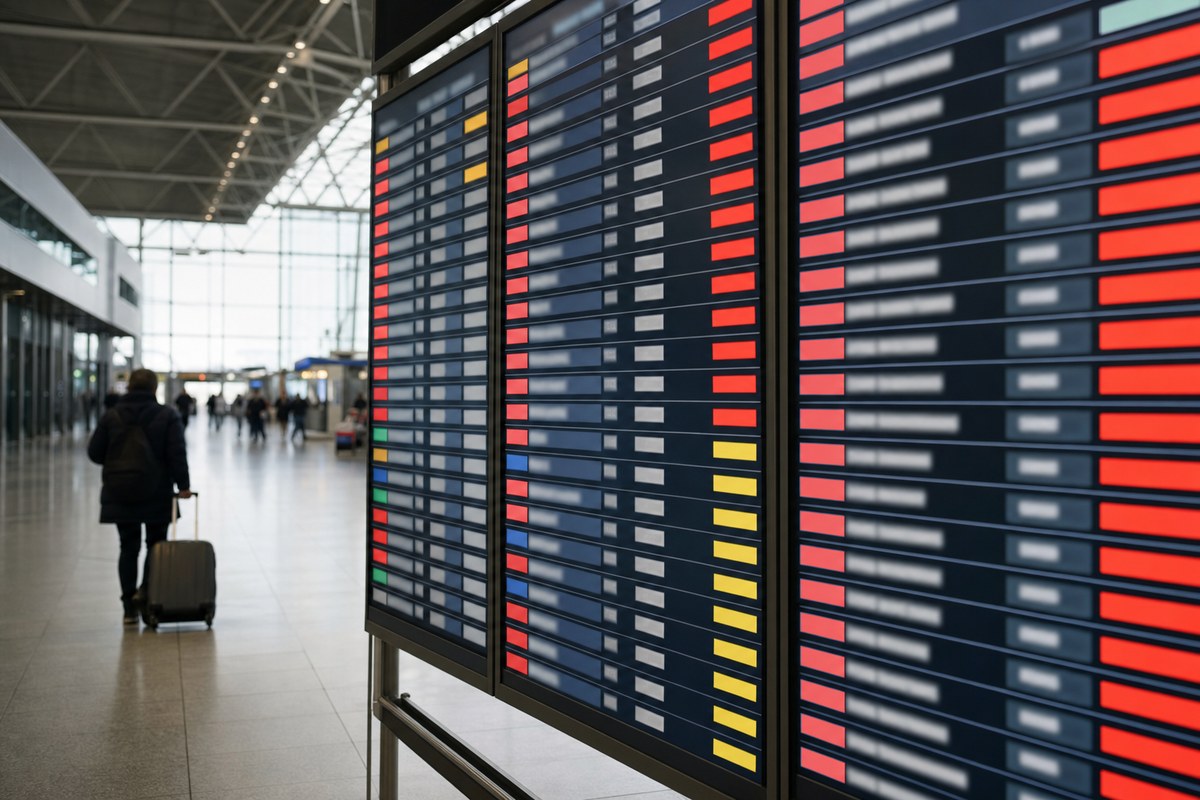
Oslo Gardermoen Airport recorded the highest cancellation count among affected airports, with 75 flights cancelled and 202 delays; SAS accounted for 31 of those cancellations. Bergen Flesland recorded 13 cancellations, according to FAQ data cited in the report. The disruption cascaded to other European airports: London Gatwick recorded 241 delays and 7 cancellations, with [easyJet](/entities/17120ed6065e5e3ca52557917ce29fb9) accounting for 126 delays; Paris Charles de Gaulle logged 234 delays and 9 cancellations, with [Air France](/entities/2791a1c72ac35145aec5652f8fc6aca0) responsible for 90 delays; Amsterdam Schiphol reported 201 delays and 11 cancellations, with KLM accounting for 77 delays; and Rome Fiumicino recorded 238 delays and 2 cancellations, with [ITA Airways](/entities/bc432b778f4e5a4f9062ab19b64212e3) accounting for 106 delays.
Flight tracking data was recorded on August 23, 2026, at 1:03 pm ET (5:03 pm GMT) via FlightAware. Passengers whose flights are cancelled within the European Union may be entitled to rebooking, meals, hotel accommodation during overnight delays, and potential cash compensation under Regulation EC 261/2004, depending on the circumstances of the cancellation.
Industry impact & what to watch
A localized labor dispute at one air navigation service provider shows how quickly disruption spreads through a network built on overflight corridors and connecting banks. Norway's controller strike did not stay contained to Oslo Gardermoen or Bergen Flesland; it registered as hundreds of delays at Gatwick, Charles de Gaulle, Schiphol and Fiumicino, airports with no direct operational tie to Avinor beyond shared airspace and rotation patterns.
Scheduled carriers absorb this kind of shock through rebooking and EU261 compensation frameworks, but the knock-on delays at downstream airports illustrate why a single national controller action can outlast its own borders in effect. The unequal spread, heaviest at Oslo, still substantial hundreds of miles away, points to how aircraft and crew rotations propagate a domestic strike into a continental delay event.
What happens next depends on how long the Avinor action continues and whether Luftfartstilsynet's coordination reduces the cancellation count at Oslo Gardermoen and Bergen Flesland. The next signal to watch is whether delay counts at Gatwick, Charles de Gaulle, Schiphol and Fiumicino recede once [Norwegian](/entities/b5d69c8d1a7b5c08b3b79ee128ecb4ba) traffic normalizes, or whether backlog effects persist into following days.
Who this affects
- Business Charter Operators — Flights routing through Oslo, Bergen, or connecting hubs like Gatwick and Schiphol face controller-strike-driven delay risk despite no direct link to the Norwegian dispute.
- Charter Brokers — Clients booked through Oslo, Bergen or the affected connecting airports should be warned of elevated delay risk tied to the ongoing controller action.
- Commercial Airports — Gatwick, Charles de Gaulle, Schiphol and Fiumicino are each absorbing hundreds of delays from a labor dispute outside their own operations.
- Air Traffic Management (ATM) Authorities — National aviation authorities face pressure to coordinate responses when a domestic controller strike produces delay counts abroad.
The underlying facts come from the originating publisher (linked above). The narrative, industry-impact assessment and per-role analysis below are produced independently by the AVI-GO intelligence team from public information. Cite as: AVI-GO, "Norway Air Traffic Controller Strike Causes 150 Flight Cancellations and 2,110 Delays Across Europe" news brief, 2026-08-24.
How to cite
AVI-GO, “Norway Air Traffic Controller Strike Causes 150 Flight Cancellations and 2,110 Delays Across Europe”. https://ai.avi-go.com/news/ai-news-center/news-briefs/norway-air-traffic-controller-strike-causes-150-flight-cancellations-a-840a83261a7ecb236fbdb1885bfb0736
Figures carry an explicit measurement window — cite the window shown on this page, not the date you retrieved it.