Convair XF2Y-1 Sea Dart: History of the Only Seaplane Ever to Break the Sound Barrier
Convair's XF2Y-1 Sea Dart broke the sound barrier in a shallow dive over San Diego Bay on 3 August 1954, remaining the only seaplane ever to do so.
Original report
migflug.com
Industry impact
The programme illustrates how a niche aerospace solution can be rendered obsolete by parallel advances elsewhere, in this case carrier-deck technology replacing the need for water-based supersonic operations.
The Convair XF2Y-1 Sea Dart remains the only seaplane in history to exceed the speed of sound, achieving the feat on 3 August 1954 during a shallow dive over San Diego Bay. The programme began around 1948, when the U.S. Navy sought an alternative to runway-hungry supersonic jets by using the ocean as a runway, and selected Convair, already developing delta-wing aircraft like the XF-92A and F-102 Delta Dagger, to build the concept. The design featured a watertight delta-wing hull, high-mounted engine intakes, and retractable hydro-skis that deployed at roughly 10 mph to lift the hull clear of the water.
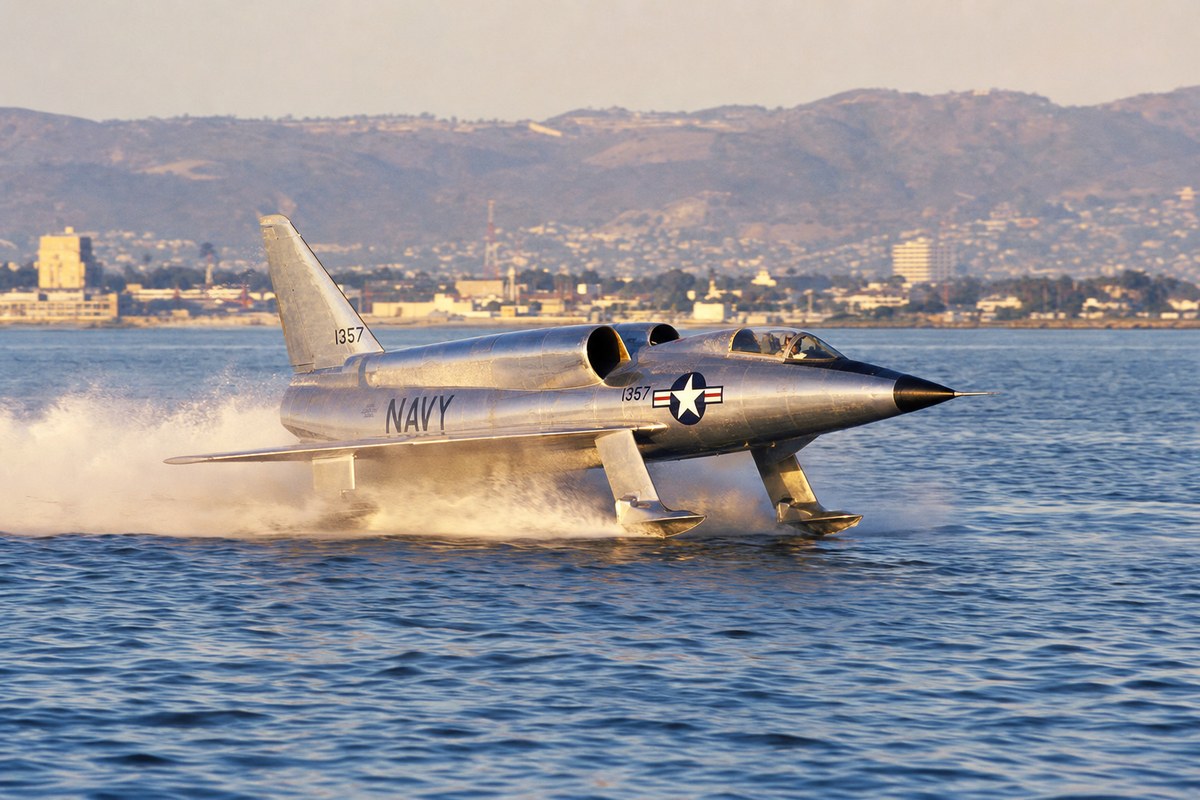
The Sea Dart's official first flight came on 9 April 1953 over San Diego Bay, though a test pilot had unintentionally become airborne during a fast taxi run the previous January. Underpowered engines and violent vibration from the twin hydro-skis plagued early testing, with test pilot B.J. Long sustaining nine Gs off ocean swells during one flight; Convair later replaced the twin skis with a single wider ski, easing but not eliminating the problem. With more powerful afterburning engines, the aircraft exceeded Mach 1 in a shallow dive on 3 August 1954, though it never reached supersonic speed in level flight due to drag from its pre-area-rule fuselage.
The programme ended in disaster on 4 November 1954, when test pilot Charles Richbourg died after lighting the afterburners during a high-speed low pass triggered a divergent pitch oscillation that broke the aircraft apart in front of assembled press and Navy officials. The crash accelerated a cancellation already underway, as advances in angled flight decks and carrier landing systems had made supersonic jets compatible with carrier operations. Five Sea Darts were built, only three ever flew, and the programme was formally cancelled in the late 1950s, with surviving airframes preserved at museums in San Diego, Florida, and Pennsylvania.
The underlying facts come from the originating publisher (linked above). The narrative, industry-impact assessment and per-role analysis below are produced independently by the AVI-GO intelligence team from public information. Cite as: AVI-GO, "Convair XF2Y-1 Sea Dart: History of the Only Seaplane Ever to Break the Sound Barrier" news brief, 2026-08-24.
How to cite
AVI-GO, “Convair XF2Y-1 Sea Dart: History of the Only Seaplane Ever to Break the Sound Barrier”. https://ai.avi-go.com/news/ai-news-center/news-briefs/convair-xf2y-1-sea-dart-history-of-the-only-seaplane-ever-to-break-the-41f6741f269ab53a560e6c7c8448288c
Figures carry an explicit measurement window — cite the window shown on this page, not the date you retrieved it.