ATR 72-201 and ATR 72-202: Specifications, Performance, and Charter Use Cases
The ATR 72-201 and ATR 72-202, early variants of the ATR 72-200 series certified in September and December 1989 respectively, remain in active regional and charter service worldwide.
Original report
jettly.com
Industry impact
Continued operational reliance on 1989-era turboprops highlights sustained regional and charter demand for short-field, fuel-efficient aircraft on underserved routes.
The ATR 72-201 and ATR 72-202 are early-production variants of the ATR 72-200 series, a twin-engine turboprop regional airliner that first entered service in 1989 with [Finnair](/entities/ac5de6909cad5819956ea8094d330474). Both are powered by twin Pratt & Whitney Canada PW124B engines producing approximately 2,160 shaft horsepower each at takeoff, fitted with four-bladed Hamilton Standard propellers and retractable tricycle landing gear suited to shorter and semi-prepared runways. The ATR 72-201 was certified in September 1989 with passenger doors at both ends of the fuselage for faster group boarding, while the ATR 72-202 was certified in December 1989 with a large forward cargo door and rear passenger door enabling mixed passenger-cargo operations. The ATR 72-202 has a maximum takeoff weight of 22,800 kg and seats up to 70 passengers, while the ATR 72-201's maximum takeoff weight is approximately 22,000 kg.
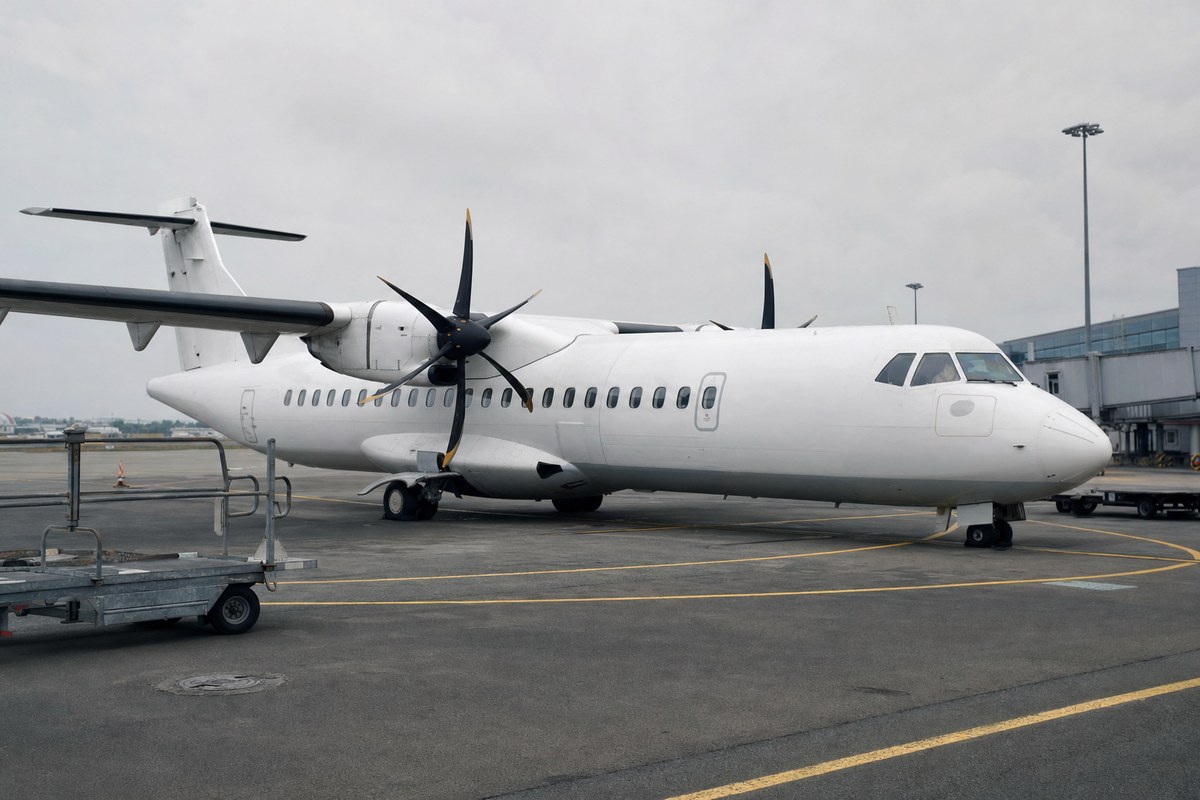
Both variants share a cruise speed of approximately 278 knots (about 515 km/h), a service ceiling of 25,000 feet, and a range of approximately 951 nautical miles, with takeoff distance at maximum takeoff weight of about 1,409 metres and landing distance of about 1,036 metres, allowing operations from runways as short as 3,800 feet. The fuselage is approximately 27.2 metres long with a wingspan over 27.0 metres and height of about 7.65 metres, while the cabin spans roughly 18 to 19 metres in length and about 2.57 metres in width, seated 2-by-2 with seat pitch of 29 to 32 inches depending on the operator.
The ATR 72 evolved from the smaller ATR 42 with a stretched fuselage and greater payload capacity, preceding the later -500 and -600 upgrades, and both -201 and -202 variants remain in service with airlines and charter operators on routes such as Milan–Rome, Paris–Bordeaux, Jakarta–Surabaya, Bangkok–Chiang Mai, Sydney–Canberra, and inter-island Caribbean and Mediterranean flights. Charter use cases include corporate shuttles, sports team travel, incentive trips to island resorts, event and conference movements, and commercial airline charter replacements on underserved routes.
The underlying facts come from the originating publisher (linked above). The narrative, industry-impact assessment and per-role analysis below are produced independently by the AVI-GO intelligence team from public information. Cite as: AVI-GO, "ATR 72-201 and ATR 72-202: Specifications, Performance, and Charter Use Cases" news brief, 2026-08-24.
How to cite
AVI-GO, “ATR 72-201 and ATR 72-202: Specifications, Performance, and Charter Use Cases”. https://ai.avi-go.com/news/ai-news-center/news-briefs/atr-72-201-and-atr-72-202-specifications-performance-and-charter-use-c-56f21f99a2ca42d7de47f757dbfcf37d
Figures carry an explicit measurement window — cite the window shown on this page, not the date you retrieved it.