Tropical Storm Moke advances toward Hawaii as winds strengthen - PBS
Tropical Storm Moke, with 50 mph winds, was tracking 470 miles southeast of Hilo on Saturday and is set to bring more rain to Hawaii's Big Island, still recovering from Hurricane Lala's 43.54 inches of rain.
Original report
www.pbs.org
Industry impact
Sequential storm systems hitting the same recovering region compound infrastructure strain, showing how flight operations near disaster zones must reassess conditions storm-by-storm rather than assuming recovery time between events.
What happened
Tropical Storm Moke advanced toward Hawaii on Saturday, positioned about 470 miles (755 kilometers) southeast of Hilo and moving west-northwest at 12 mph (19 kph) as of 5 a.m. Saturday, with maximum sustained winds around 50 mph (85 kph), according to the National Hurricane Center. The storm formed Friday in the Pacific Ocean and is expected to pass south of the Big Island late Saturday into early Sunday before continuing westward near the islands through early Tuesday, said Casey Oswant, a meteorologist with the National Weather Service in Honolulu.
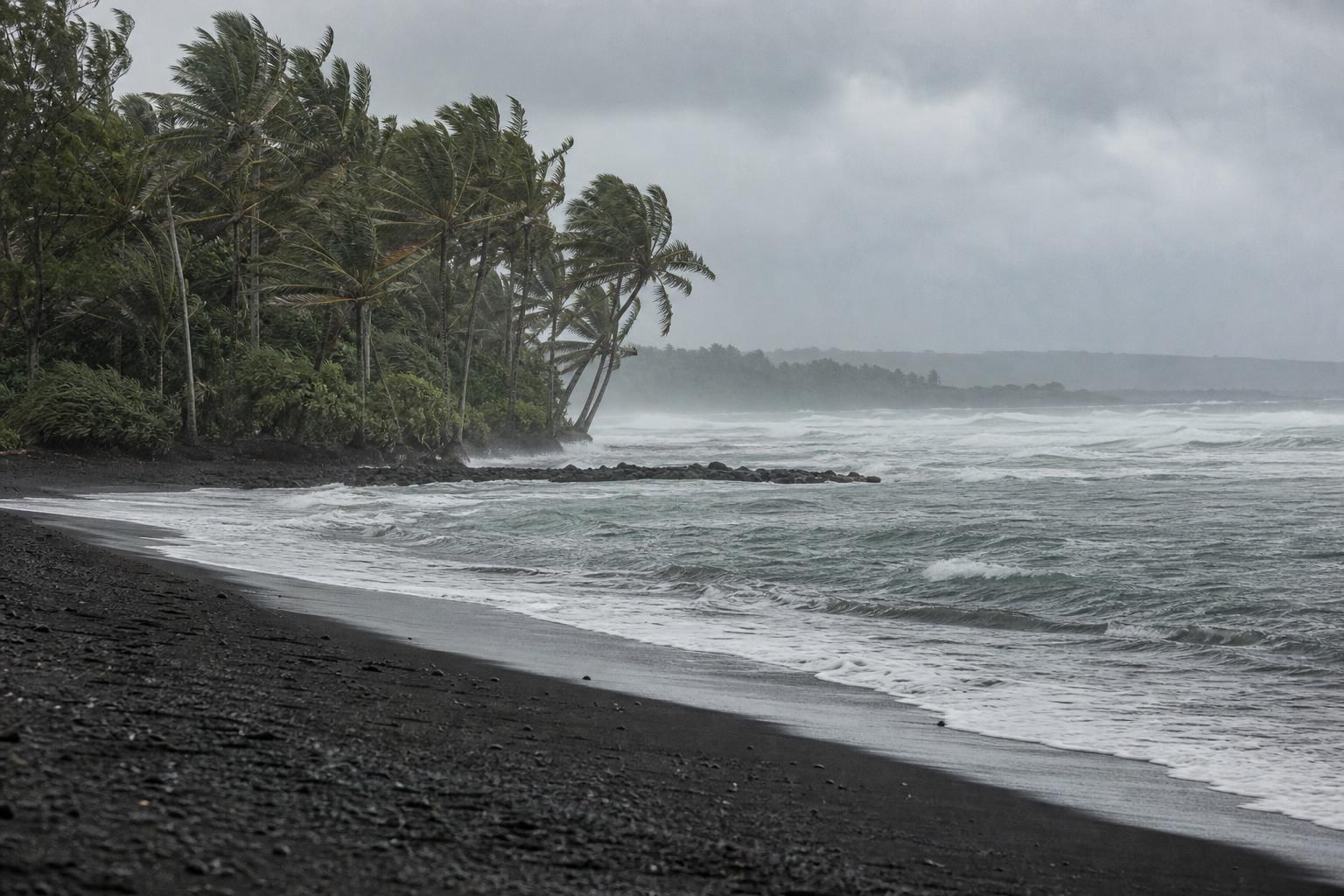
The Big Island is still recovering from Hurricane Lala, which downed trees, swept buildings off their foundations, damaged roads and bridges, and left roads covered in mud and rocks. One storm-related death was reported from Lala. The northeast coast of the Big Island recorded the heaviest rainfall total from Lala at 43.54 inches (1.1 meters), and about 9,000 customers on the Big Island remained without power Saturday.
Oswant said rainfall predictions for the weekend put the southeast and windward sides of the Big Island at 5 to 10 inches (13 to 25 centimeters), with as much as 15 inches (38 centimeters) possible in isolated areas. The rest of the island chain was expected to see 1 to 2 inches (2 to 5 centimeters), though parts of east Maui could get up to 4 inches (10 centimeters). No coastal watches or warnings were in effect early Saturday morning. Hawaii Gov. Josh Green and other state officials held a news conference ahead of Moke, urging residents to restock food, medicine and other essentials. Oswant said impacts from Moke would probably be "a little bit more limited than what we saw with Lala," though the windward and southeast sides of the Big Island would still be affected. Tiffany Edwards Hunt, a teacher living in Keaau on the east side of the Big Island, said there was "definitely tension in the air" over more rain in communities where floodwaters had turned into rivers.
Industry impact & what to watch
A second storm arriving before a region has finished repairing roads, bridges and power lines illustrates how compounding weather events can extend disruption well beyond a single storm's landfall window. Ground infrastructure already weakened by one system, such as the roads and bridges damaged by Lala, is more vulnerable to a follow-on storm's rainfall even when that storm carries lower wind speeds.
Aviation and logistics operators serving the Big Island depend on real-time National Weather Service guidance for both storms rather than treating post-Lala recovery timelines as fixed, since Moke's path and intensity were still being tracked as of Saturday morning. The absence of coastal watches or warnings as of early Saturday means the situation could still escalate.
The next fixed points to watch are Moke's passage south of the Big Island late Saturday into early Sunday and its continued track near the islands through early Tuesday, along with whether the roughly 9,000 customers still without power from Lala see restoration before Moke's rains arrive.
Who this affects
- General Aviation Airports — Big Island general aviation airfields face further weather exposure while still recovering from Lala's flooding and power outages.
- Business Charter Operators — Operators serving the Big Island should plan around forecast rainfall of up to 15 inches and gusty conditions as Moke passes close by.
- Charter Brokers — Brokers arranging Big Island or east Maui trips should warn clients of possible delays as Moke tracks through the region into early Tuesday.
The underlying facts come from the originating publisher (linked above). The narrative, industry-impact assessment and per-role analysis below are produced independently by the AVI-GO intelligence team from public information. Cite as: AVI-GO, "Tropical Storm Moke advances toward Hawaii as winds strengthen - PBS" news brief, 2026-08-24.
How to cite
AVI-GO, “Tropical Storm Moke advances toward Hawaii as winds strengthen - PBS”. https://ai.avi-go.com/news/ai-news-center/news-briefs/tropical-storm-moke-advances-toward-hawaii-as-winds-strengthen-pbs-59312ebb78bb37818a16d2ae50ee1b5d
Figures carry an explicit measurement window — cite the window shown on this page, not the date you retrieved it.