Flight Delays Surge at Doha's Hamad International as Middle East Airspace Restrictions Persist
Flight delays climbed at Doha's Hamad International and other Gulf hubs in August, with more than one hundred cancellations recorded at Jeddah's King Abdulaziz International Airport amid persistent conflict-related airspace restrictions.
Original report
www.thetraveler.org
Industry impact
Prolonged airspace restrictions force regional aviation onto a narrower set of corridors, leaving capacity, routing and scheduling reliability structurally exposed even as overall disruption levels ease.
What happened
Flight delays increased sharply at Hamad International Airport in Doha and other major Gulf hubs, adding to disruptions across a regional aviation network still operating under conflict-related airspace restrictions stemming from the 2026 Middle East conflict. Doha continues to operate within a tightly managed airspace environment, with flights constrained to specific corridors.
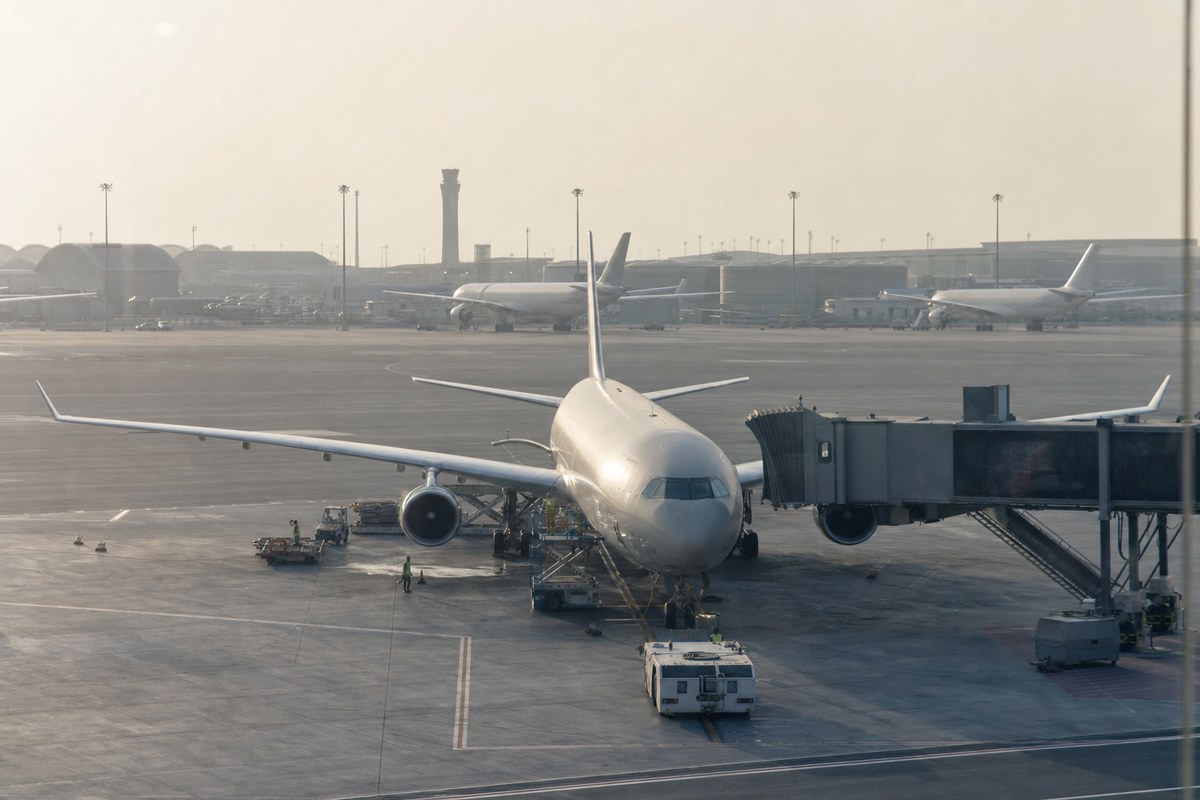
Qatar's airspace was closed and reopened several times between February and July 2026 as the conflict escalated, before returning to more regular operations through defined flight corridors. Some national regulators continue to discourage or prohibit certain carriers from entering Qatari airspace, pushing traffic onto a smaller set of neighboring corridors. At King Abdulaziz International Airport in Jeddah, independent tracking has recorded more than one hundred flight cancellations so far in August, alongside a steady stream of delays. Airports in Dubai, Abu Dhabi, Riyadh, and Kuwait City are also experiencing elevated disruption levels.
European regulators have issued safety advisories urging operators to avoid or limit flights through the airspace of Bahrain, Kuwait, Qatar, and the United Arab Emirates, as well as certain sections of the Gulf of Oman, restricting available routes and flight levels and creating bottlenecks where traffic converges. Coordination bodies note that operations across the region have stabilised compared with the earliest weeks of the conflict, but still face reduced capacity at some hubs for the remainder of the current scheduling season. The 2026 Gulf conflict triggered the cancellation or severe delay of tens of thousands of flights across the wider Gulf region in its early weeks.
Industry impact & what to watch
This is what a regional airspace restriction does once the acute phase passes: the closures end, but the corridors that replace open airspace stay narrower than before, and traffic that used to spread across multiple routes now converges on fewer of them. That convergence is what produces delays and cancellations even when every airport involved is technically open.
In a network built around hub connectivity, capacity at any single node depends on the routes feeding it as much as on the runway itself. When advisories push several countries' worth of traffic onto a reduced set of corridors, congestion and tactical rerouting become structural features of the schedule rather than one-off events, and GPS interference adds a further layer of unpredictability to approaches and transits.
Whether conditions improve depends on whether the national regulators still discouraging or prohibiting carriers from Qatari airspace revise their guidance, and whether the European advisories covering Bahrain, Kuwait, Qatar, the UAE and parts of the Gulf of Oman are narrowed as the scheduling season progresses. Cancellation counts at Jeddah and delay levels at Dubai, Abu Dhabi, Riyadh and Kuwait City over the coming weeks will show whether the stabilisation coordination bodies describe is holding or slipping.
Who this affects
- Business Charter Operators — Business jet operators routing near Doha, Jeddah or other Gulf hubs face a higher risk of delay or cancellation as traffic concentrates on fewer corridors.
- Charter Brokers — Clients booked through Gulf hubs should be warned of ongoing delay and cancellation risk tied to restricted airspace corridors.
- Commercial Airports — Major Gulf airports including Doha and Jeddah continue to manage congestion and reduced capacity tied to airspace restrictions.
- Air Traffic Management (ATM) Authorities — Regulatory advisories restricting Gulf airspace continue to shape available routes and flight levels across the region.
The underlying facts come from the originating publisher (linked above). The narrative, industry-impact assessment and per-role analysis below are produced independently by the AVI-GO intelligence team from public information. Cite as: AVI-GO, "Flight Delays Surge at Doha's Hamad International as Middle East Airspace Restrictions Persist" news brief, 2026-08-24.
How to cite
AVI-GO, “Flight Delays Surge at Doha's Hamad International as Middle East Airspace Restrictions Persist”. https://ai.avi-go.com/news/ai-news-center/news-briefs/flight-delays-surge-at-doha-s-hamad-international-as-middle-east-airsp-ecbd63814f7d6518a4fb4ceceadb0480
Figures carry an explicit measurement window — cite the window shown on this page, not the date you retrieved it.