CU Boulder Researcher Discovers Two Phenomena to Reduce Aircraft Drag Using Engineered Subsurface Vibrations
CU Boulder engineer Mahmoud I. Hussein and his team reported two discoveries, super-resonance and scatterless interference, using engineered subsurface vibrations to reduce aircraft boundary-layer turbulence and potentially improve fuel efficiency.
Original report
www.colorado.edu
Industry impact
If validated in wind tunnels, subsurface vibration control could open a new drag-reduction pathway for aerospace, marine and turbomachinery applications beyond traditional vehicle shaping.
A University of Colorado Boulder aerospace engineer has reported two breakthrough discoveries that could use engineered microscopic vibrations to reduce boundary-layer turbulence on passenger jets, potentially improving fuel efficiency. Mahmoud I. Hussein, a professor in the Ann and H.J. Smead Department of Aerospace Engineering Sciences, and his team published findings on super-resonance in Physical Review X and on scatterless interference in Proceedings of the Royal Society A.
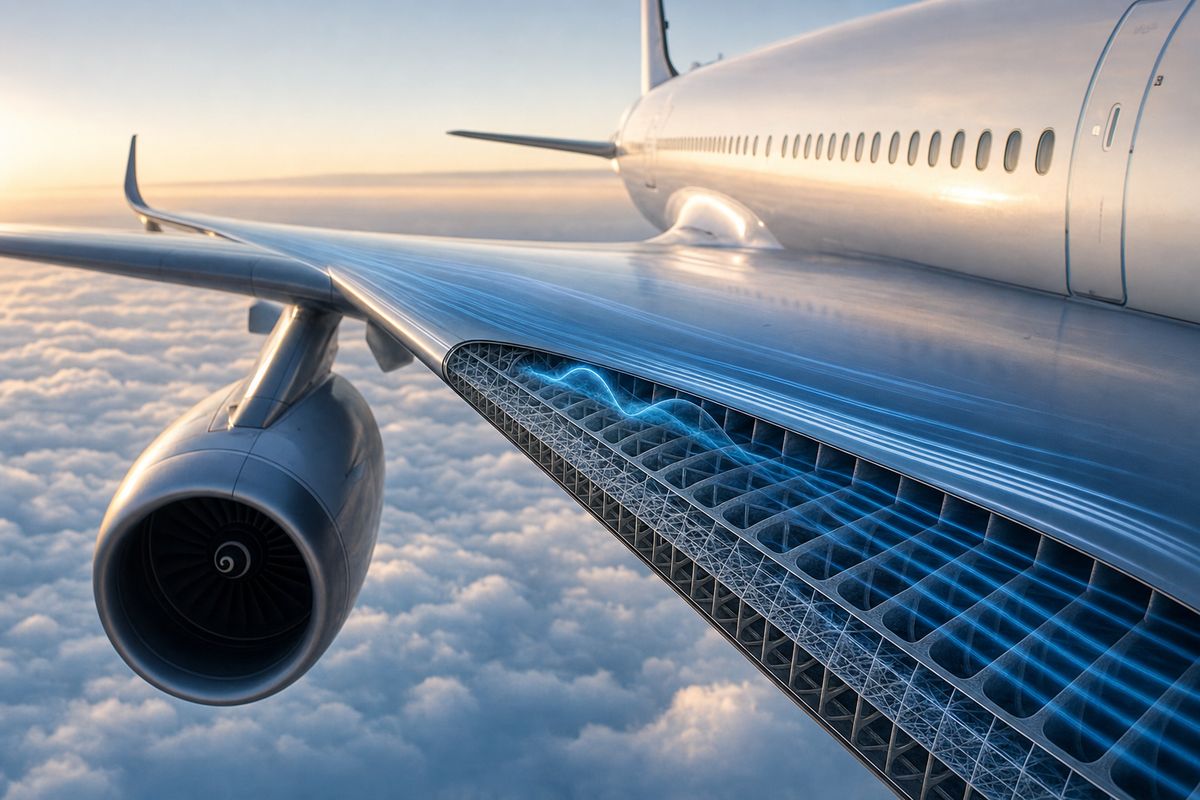
The research centers on phononic subsurfaces, synthetic subsurface materials that passively manipulate vibrations on surfaces interacting with fluid flow, a concept Hussein introduced in 2015 but which until now could only operate at a single frequency. By coiling PSub structures, the team demonstrated vibrations can be manipulated across a broad range of frequencies, called super-resonance, while the second discovery, scatterless interference, shows groups of PSubs arranged in a grid can delay turbulence across a large surface such as an aircraft wing. Hussein said the prevailing paradigm since the beginning of aviation has been to control drag only by shaping the vehicle, and this offers a new concept using materials that dynamically interact with airflow.
Commercial aircraft consume over 10,000 gallons of jet fuel on a single cross-country trip. Adam Harris, a PhD student in Hussein's lab, co-authored both papers, alongside Armin Kianfar of the Aerospace Corporation, Christoph Brehm of the University of Maryland, College Park, and Daniel Yago and David Roca of the Polytechnic University of Catalonia. The current research is computational, though other groups have built physical PSub prototypes and are working toward wind tunnel demonstrations, and the work is supported by a $7.5 million, five-year Department of Defense Office of Naval Research Multidisciplinary University Research Initiative grant.
The underlying facts come from the originating publisher (linked above). The narrative, industry-impact assessment and per-role analysis below are produced independently by the AVI-GO intelligence team from public information. Cite as: AVI-GO, "CU Boulder Researcher Discovers Two Phenomena to Reduce Aircraft Drag Using Engineered Subsurface Vibrations" news brief, 2026-08-23.
How to cite
AVI-GO, “CU Boulder Researcher Discovers Two Phenomena to Reduce Aircraft Drag Using Engineered Subsurface Vibrations”. https://ai.avi-go.com/news/ai-news-center/news-briefs/cu-boulder-researcher-discovers-two-phenomena-to-reduce-aircraft-drag-b770fb624cba29bf9daf99500779d8f2
Figures carry an explicit measurement window — cite the window shown on this page, not the date you retrieved it.